

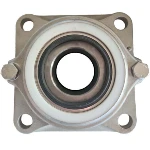
Allow for Thermal Expansion and Contraction
Expansion clearance in standard Extreme Bearing configurations
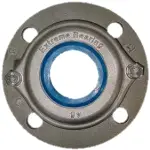
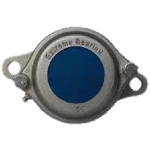
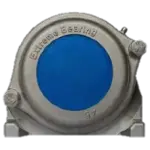
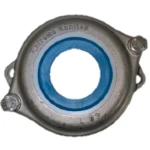
Standard Extreme Bearing units provide thermal expansion clearance equal to the thickness of the locating ring. When operating temperature differences occur between the shaft and the support structure, thermal expansion and contraction must be accounted for to preserve optimal internal bearing clearance.
Additionally, structural deflection or bending under heavy loads can consume bearing clearance, potentially leading to rolling element binding. Therefore, it is best practice to configure one bearing as a non-locating (free) bearing to retain adequate axial movement.
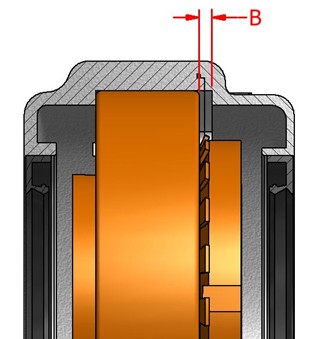
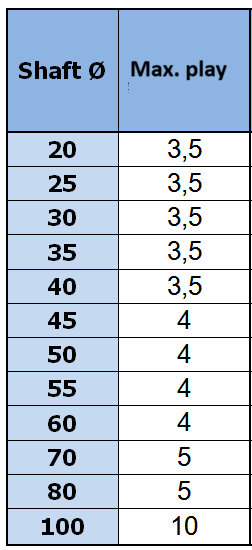
Calculating maximum shaft length for standard Extreme Bearings
Operating temperatures directly affect the required shaft length. When installing long shafts, you must calculate thermal expansion or contraction and adjust bearing positions accordingly.
- Stainless steel: expands by ~0.016 mm per metre for every 1°C temperature rise.
- Carbon steel: expands by ~0.012 mm per metre for every 1°C temperature rise.
The table shows the allowable shaft length (m) based on the temperature difference between the shaft and the support structure. Longer shafts or higher temperatures require greater internal axial movement in the housing to maintain optimal clearance for the rolling elements.
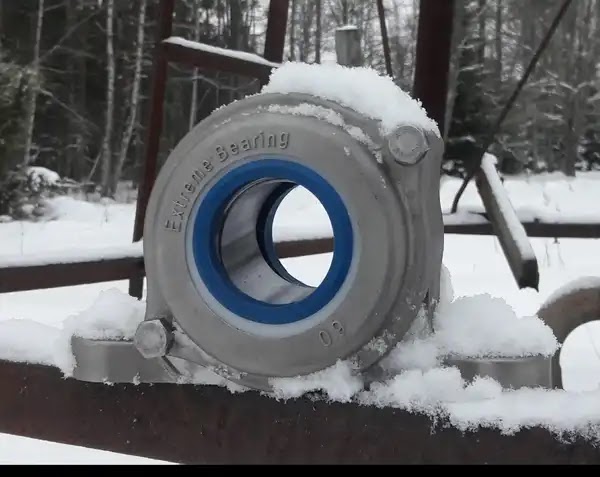
Keep in mind that a 50°C temperature difference can occur very quickly. For example, if a machine operates in winter conditions at -10°C and a hot product warms the conveyor drum shaft to +40°C, you immediately reach a 50°C differential.
Allowable shaft length (m) per temperature difference
| Shaft Ø (mm) | Max. play (mm) | Material | 50°C | 100°C | 150°C | 200°C | 250°C |
|---|---|---|---|---|---|---|---|
| 20 – 40 | 3.5 | Carbon steel | 5.83 | 2.92 | 1.94 | 1.46 | 1.17 |
| 20 – 40 | 3.5 | Stainless steel | 4.38 | 2.19 | 1.46 | 1.09 | 0.88 |
| 45 – 60 | 4.0 | Carbon steel | 6.67 | 3.33 | 2.22 | 1.67 | 1.33 |
| 45 – 60 | 4.0 | Stainless steel | 5.00 | 2.50 | 1.67 | 1.25 | 1.00 |
| 70 – 80 | 5.0 | Carbon steel | 8.33 | 4.17 | 2.78 | 2.08 | 1.67 |
| 70 – 80 | 5.0 | Stainless steel | 6.25 | 3.13 | 2.08 | 1.56 | 1.25 |
| 100 | 10.0 | Carbon steel | 16.67 | 8.33 | 5.56 | 4.17 | 3.33 |
| 100 | 10.0 | Stainless steel | 12.50 | 6.25 | 4.17 | 3.13 | 2.50 |
For more information
If anything is unclear, do not hesitate to contact us for more information. Our engineers are happy to help you.